

Do something for 21 days and it becomes a habit.” Most of us have heard this. Many of us have tried counting the days, too. But when you look at real research, 21 days is almost three times too short. Most people need about two months before a new habit feels natural, like something they do without thinking.
So where did the number 21 come from? Why do some people build habits faster than others? And how can you make a new habit easier to keep?
What is the 21-day rule, and where did it come from?
The 21-day rule is the idea that if you repeat something every day for 21 days, it will turn into a habit.
It comes from a 1960 book called Psycho-Cybernetics by Maxwell Maltz, an American plastic surgeon. He noticed that his patients needed “a minimum of about 21 days” to get used to their new face after surgery (Scientific American).
So the number came from one doctor watching his patients. It was not a study about habits. And as people kept repeating it over the years, the words “a minimum of” slowly disappeared.
We think 21 days is not useless. It’s a first goal that doesn’t feel too far away. The problem is that many people expect the habit to be automatic on day 21. When it still feels like hard work, they think they failed, and they quit.
How long does it really take to form a habit?
The study people quote most is by Phillippa Lally and her team at University College London, published in 2010.
They asked 96 volunteers to pick one new thing to do every day in the same situation. For example, drink a glass of water after breakfast, or go for a run before dinner. Every day, people rated how automatic the action felt. The study ran for 84 days.
The middle result was 66 days. The fastest person took 18 days. For the slowest, the researchers estimated it could take up to 254 days (The Behavioral Scientist).
In 2024, a review looked at 20 studies with 2,601 people in total. It found a similar middle point of 59 to 66 days, with a range from 4 days to 335 days (Singh et al.).
In short, most people need about two months. But there is no single number that works for everyone.
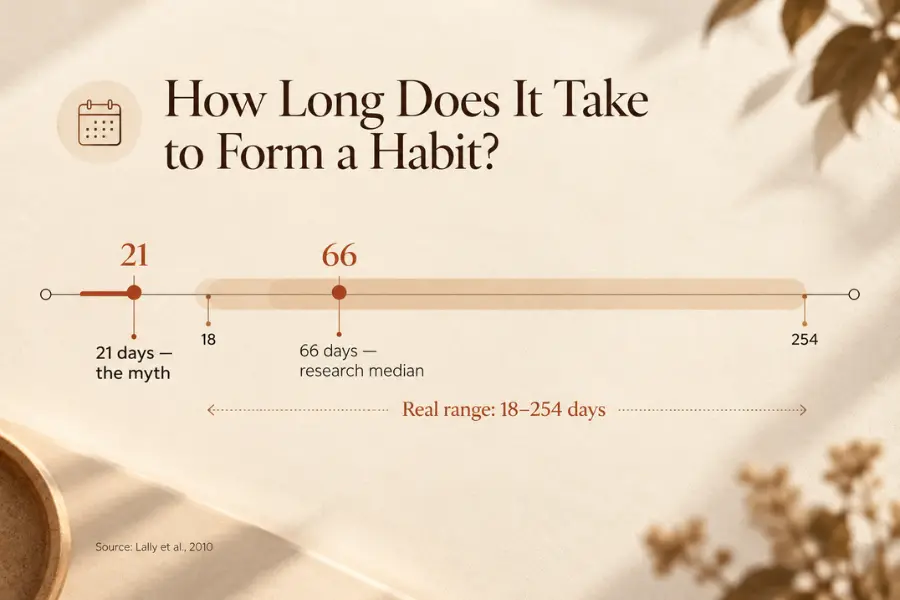
The way we see it, the first 21 days are when something new starts to feel familiar. The weeks after that are when it slowly becomes part of who you are. Seen this way, day 21 is not the finish line. It’s just a checkpoint.
Why do some people form habits faster than others?
The time is so different from person to person because a few things can speed a habit up or slow it down.
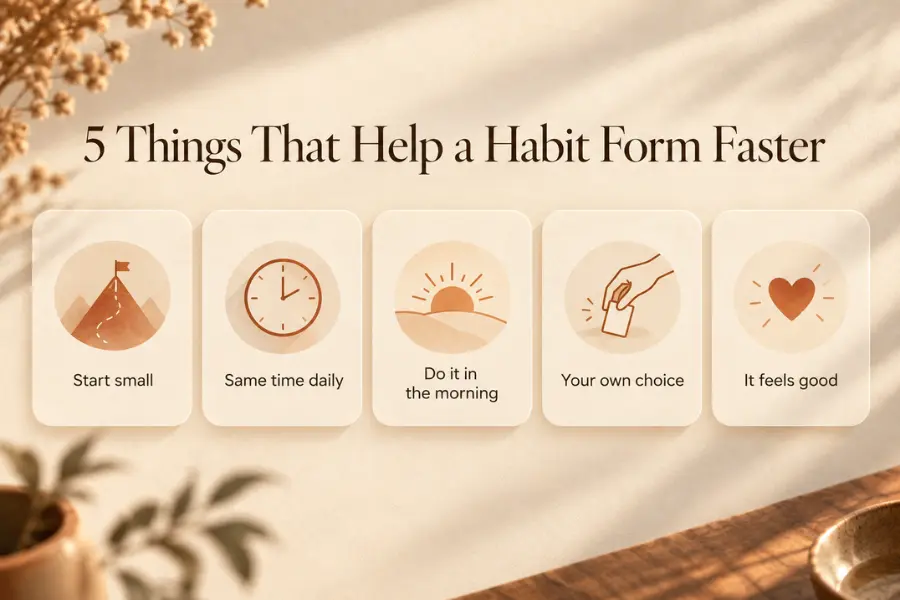
- How hard the habit is. In Lally’s study, the middle result for exercise was 91 days, while drinking water was 59 days. This gap was not big enough to be certain, but other research also finds that simple actions become habits faster (The Behavioral Scientist).
- Same time, same place. Psychologist Wendy Wood, who studies habits, explains that habits form when we repeat an action the same way in the same situation (Wharton Magazine).
- Morning or evening. The 2024 review found that morning habits last better than evening ones (BPS).
- Your choice or someone else’s. People who chose their own habit were more successful (BPS).
- Whether it feels good. If you get a small reward, the action is more likely to become a habit than something you force yourself to do every day (Wharton Magazine).
How does a habit form?
A habit is a shortcut in your brain. When you do the same thing in the same situation again and again, and it feels good, your brain links that situation to that action (Wharton Magazine).
This loop has three parts:
- The trigger. A time, a place, or something you just finished. For example, waking up.
- The action. What you do right after. For example, drinking a glass of water.
- The reward. The good feeling you get. For example, feeling fresh.
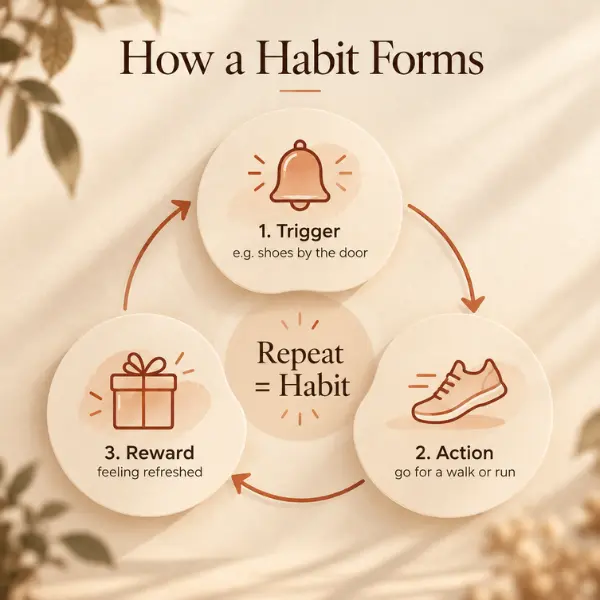
Repeat this enough times and one day you wake up and reach for the glass without thinking. That’s the moment it has become a habit.
This is why counting days is not enough. If you do the action at random times with no clear trigger, your brain has nothing to link it to.
If I miss a day, do I have to start over?
No. Lally’s study found that missing one day had almost no effect on how automatic the habit felt, and people got back on track quickly (The Behavioral Scientist).
What really breaks a habit is not one missed day. It’s the thought “I already messed up, I’ll start again next Monday,” and then stopping for a long time.
A simple rule: missing one day is okay. Just try not to miss two days in a row.
How can I make a new habit easier to keep?
Here are six simple steps based on the research above.

- Start so small you have no excuse. Want to read more? Start with one page a day. Want to exercise? Start by putting on your shoes and walking out the door. Simple actions become habits faster.
- Attach it to something you already do. Make a plan like “After I brush my teeth in the morning, I will stretch for 2 minutes.” A review of 94 tests found that “if-then” plans like this help people reach their goals more often (The Behavioral Scientist).
- Same time, same place. If you can, choose the morning.
- Make it easy to start. Put your running shoes by the door. Leave your book on your pillow. The less effort it takes, the more often you’ll do it (Wharton Magazine).
- Track it. Mark each day you do it. Tracking your progress helps you stay consistent (BPS).
- Missing a day is okay. Missing two in a row is not.
If you want to go deeper, Atomic Habits by James Clear explains these ideas with lots of everyday examples, especially how to shrink a habit down to just 2 minutes.
Should I wait for a Monday or New Year to start?
You don’t have to. But if a fresh start gives you energy, use it.
Researchers at Wharton call this the Fresh Start Effect. They found that people go to the gym more at the start of a week and after their birthday, and Google searches for “diet” peak at the start of a month and a new year. Our brains like the feeling of starting over (APS).
The “October Theory” trend on TikTok comes from the same feeling. It treats October as a new year before the new year, because there are only three months left (TODAY).
We think a fresh start can give you a push, but it shouldn’t be a reason to wait. If a new habit takes about two months anyway, every day you spend waiting for the “right time” is a day lost.
Summary
- The 21-day rule came from one doctor watching his patients. It was not a study about habits.
- Research shows most people need about two months, and it can vary a lot.
- What really helps: start small, attach it to something you already do, keep the same time, and don’t miss two days in a row.
Prefer to listen? UNMAP EP.01 talks about 21 days, 66 days, and the October Theory (in Thai with English subtitles).
Read next: All UNMAP episodes · อ่านบทความนี้เป็นภาษาไทย
This post contains affiliate links. If you buy through them, we may earn a small commission at no extra cost to you.
FAQ
Is the 21-day rule true? Not really. It came from a plastic surgeon who saw that patients needed at least about 21 days to get used to their new face. It was not based on a study about habits.
How long does it take to form a habit? Research shows most people need about two months. The middle result is 59 to 66 days, but some people are much faster and some much slower.
If I miss a day, do I have to start over? No. Missing one day has almost no effect. What matters is getting back to it, and not missing two days in a row.
How can I form a habit faster? Start small, attach it to something you already do every day, do it at the same time and place, make it easy to start, and track it.
Do I need to wait for New Year to start a habit? No. A fresh start can give you energy, but you can start any day. The sooner you start, the sooner you’ll see results.
Sources
- Scientific American: How long does it really take to form a habit?
- The Behavioral Scientist: What Lally et al. (2010) actually found
- Singh et al. (2024), Time to form a habit, Healthcare
- BPS Research Digest: How to make a habit stick
- Wharton Magazine: How to form good habits (Wendy Wood)
- The Behavioral Scientist: Implementation intentions
- APS: Why Monday is the best day for setting new goals
- TODAY: Viral October theory